
All in one sales automation salestack CRM software
Try For Free
From lead to prospect to customer, their journey is captured in the CRM. These insights put you in a better position to recognize people, their needs, and how your business can work for them.
01CRM lets you automate mundane tasks like creating leads from signup forms and sending welcome emails to new leads, CRMs minimize it.
02The CRM system becomes a single source of truth for every member in your team. No information gaps, no back-and-forth—the customer hears a consistent voice from your business.
03Being able to visualize your pipeline makes it easier for you to prioritize deals and pick them off diligently. As a result, your pipeline stays clog-free and you remain committed to the bottom line.
04Because you have a well-rounded view of your customer at all times, you can cross-sell and up-sell at the right moments, with higher success rates. This also reduces the chances of attrition.
05Information in the CRM is useful not just for your sales team, but for marketing and support too. They can plan campaigns and respond to tickets better using sales context.
06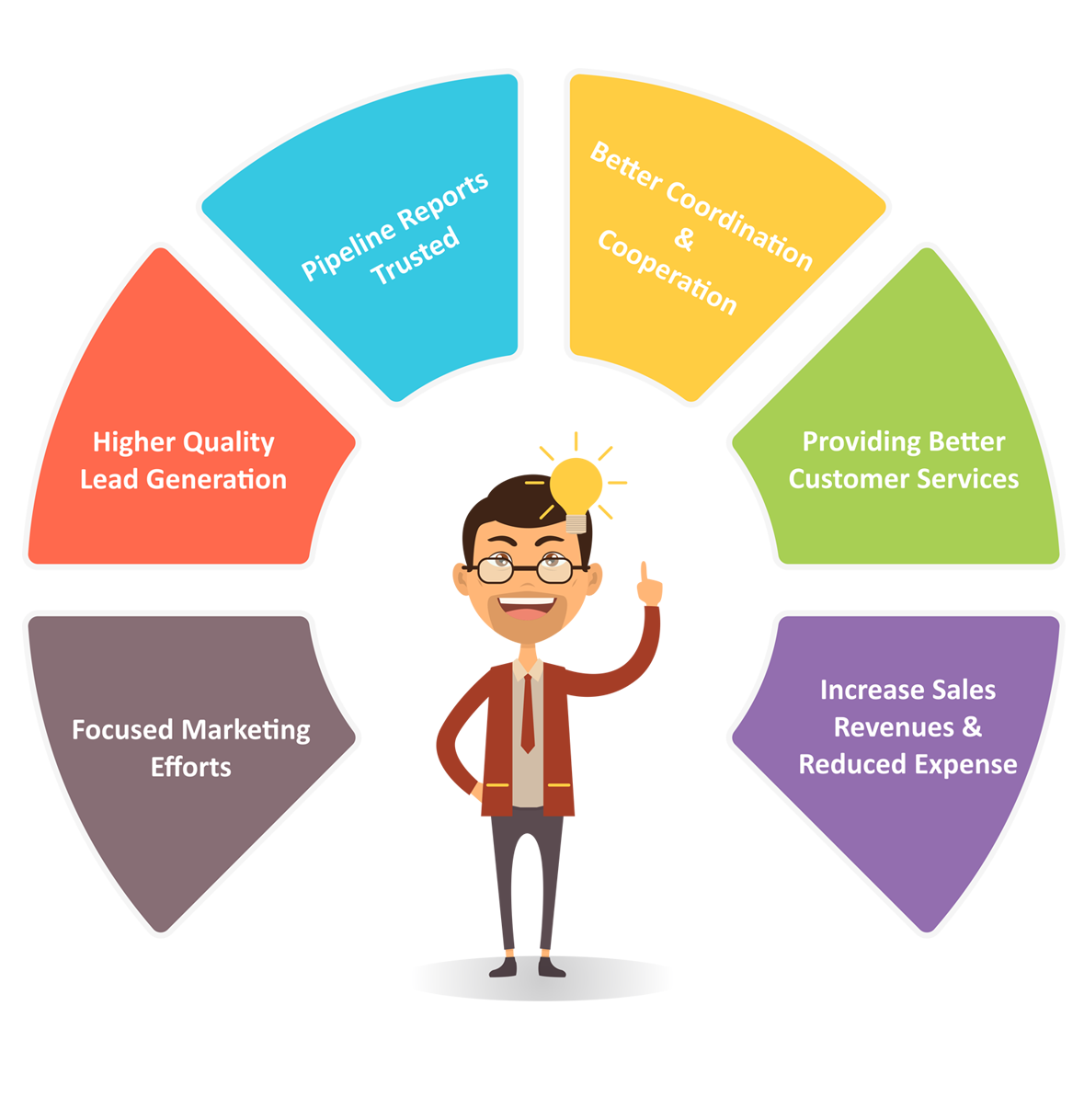
Salespeople work hard to obtain information about their customers. And then this information is strewn across their desk—their call software contains call logs, spreadsheets contain pipeline data, sticky notes have crucial information scribbled on them, and their calendar (digital or physical) keeps track of their calls and appointments. So when salespeople have to retrace their relationships with customers, or even if they need a quick update on a lead, they have to tread through multiple sources to piece together information. In a time-sensitive job like sales, this approach isn’t just infeasible, it’s unsustainable as well.
A CRM system brings all this information into one cohesive unit. The customer’s complete history with your business exists alongside a list of your deals; your emails, notes, and appointments live in one interface. We’re talking about a goldmine of information available in one system, under one roof.
CRM is therefore the one-stop solution for your sales teams. It can be the difference between winning a deal and losing it. It can also be your gateway to increased sales productivity, healthier pipelines and better coordination between (and beyond) teams. But at its core, CRM software helps you build long-lasting relationships with your customers.
Manages leads from prospecting to conversion. It lets you track sales activities, deals, and tasks and move them across sales stages. It also connects to contact management to let you view customer interactions and profiles in one window. Most CRM solutions allow you to customize the pipeline stages.
Read More
CRM's campaigns module allows you to create, track, and optimize your marketing
initiatives. Marketing campaign goals can vary, from generating brand or promotion awareness, to
obtaining new leads, converting leads to new sales, or encouraging existing clients to purchase more
products or services.
Manages campaigns from start to end, including setting up target
customers, automating workflows, and measuring success based on clearly defined metrics.
An organization is a customer account record for a customer or prospective customer. When a Lead is converted to an Opportunity, an Organization for the prospective customer is automatically created in the CRM system.
Read More
Organizes customer data in a centralized location. Contact details, demographics, transactions, customer service interactions, and other customer data are easily saved and retrieved.
Read More
A Quote is a formal statement issued by seller to the prospective buyer, basically on a request for a quotation. It contains the detailed list of Products and Services, Prices and Taxes, Dates, Parties involved, Address information, Terms and Discounts.
Read More
Send Quick SMS to customers and also bulk SMS system integrated in CRM.
Read More
Email system integrated in CRM and user can save Email Templates.
Read More
Custom Print option available in Quote, Sales Invoice and Sales Order.
Read More
Sales Order is an internal document generated within the company after the Purchase Order is received. It helps your sales team track all the Products or Services that should be manufactured, shipped etc according to the agreed prices and dates. Sales Order comprise Sales Order number, Purchase Order, Recurring Invoice, Billing and Shipping Address, Products or Services, Prices and Taxes etc.
Read More
Services refer to the free or paid assistance you would offer to benefit your
customers. In general, services are non-stock items rendered to your customers. Services do not have
bundles.
It is the act of offering paid assistance in a scheduled time frame to fulfill the
requirement of the customer. Services module is very similar to Products module, except for Stock
Information. Services are non-stock items and they do not support bundles (like Product bundles).
Services have only non-stock attributes or fields.
An invoice is a non negotiable itemized statement issued by a seller for the Products and Services rendered to the buyer. Invoice can also be called as a Bill in simple words. It usually contains the Products or Services details, Prices and Taxes, Dates, Parties involved, Address information, Terms and Discounts, and payment methods.
Read More
A vendor is a person or organization that supplies Products or Services to your company. A vendor can also be a manufacturer or a re-seller.
Read More
A purchase order is a legal document handled over to a vendor to purchase Products or Services. It offers you a channel to explain your requirements and intentions explicitly. Purchase Orders comprise the purchase order number, vendor details, product or service details, terms and conditions, prices, etc.
Read More
In the CRM terminology, tickets are any kind of customer service requests as they
occur after sales. The support functions help you to collect and sort customer requests, inquiries,
disturbances, problems etc. related to sold goods or services.
The support functions keep CRM
users and customers informed on the status reached in respect to the response to customers
messages.
Sales staff and management can get a quick overview of support activities related
to customers or products or both.
Tickets, also called as Cases, are post-sales support
requests generated by your customers. It offers your sales team the flexibility to create,
communicate, edit, and close the case after the right solution is delivered to your customers.

Service Contract is an agreement between you and your customers to provide service
on the product for a limited time period.
Service Contract is a negotiated agreement for the
products rendered to your customers. As per the agreed contracts, your support center is supposed to
offer service for the product for an agreed period of time. It boosts the level of customer
satisfaction and builds healthy trading relationships.
User can save FAQ list for support system.
Read More
Considering Project as a whole, a Project Task is a piece of work allocated to a
user or a group that should be accomplished within defined period of time.
This module can
also be used independently without associating with Projects module. A Project Task can be assigned
to a group or any individual user to accomplish the task within the specified timeline.

CRM lets you add, assign, and track actionable items and feed them into the sales pipeline. Tasks can be populated with customer data or updated with information.
Read More
Project Milestones determine the phase of great significance within project schedule. In real time scenario, like stones are placed beside roads starting the portion of journey has been completed, project milestones also indicate important achievements in project. It gives you an idea on how project is advancing.
Read More
Multiple Users supported system with manage own data.
Read More
Userwise Dashboard and User work history on Dashboard.
Read More
Consolidates streams of data in meaningful ways that help you to spot patterns, trends, behaviors, and other market insights. Many CRM solutions can also generate real-time data that makes reporting more timely and accurate.
Read More
For quick future reference, it adds all vital customer-related e-mails in CRM. In addition, it also stores all the details of customer’s call and meetings. In order to have a streamlined sales process, it manages daily tasks to the CRM users.
Read More
Opportunity represents a sales opportunity. On qualifying a lead, create an Opportunity. Sales Stage field in the Opportunity is used to identify the progress of the Sale towards completion. Amount and Expected Close Date fields in an Opportunity drive the Sales Pipeline reports.
Read More